
Business and Technical Process Management
Modeling,
Analysis and Simulation
In managing real world business and technical processes, it's often
useful to build and analyze models of those processes (i.e. conduct
process model simulations). Generally, process model
simulations will help to obtain better process understandings by
identifying process uncertainties, estimating process response to
future factors, providing a focal point for stakeholder
communication during process change, and comparing the relative
impact of competing process designs. To give believability to
these model understandings, it's important to establish the proper
relationships between the real world process, the model of the real
world process, the simulation of the modeled real world process and
the analysis/validation of the simulation results -- if these
relationships aren't carefully and correctly established, process
understandings will be, to a greater or lesser extent,
useless. The overall solution delivery process is addressed here. The real world/model/simulation
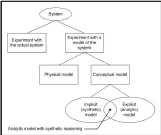
relationship is summarized in the following figure1,
discussed in more detail in my Notes on Systems Modeling for
Simulation and demonstrated in the examples that follow.

|
The business/technical processes and simulation models I'm most interested in fall into two categories, functional and operational:
Functional Process Models: processes directly related to the functional requirements of the system.
Value-centric : focuses on high level process values delivered to customers (e.g. a corporate-level vision).
Activity-centric : focuses on interaction of functional process activities and tasks (e.g. a process methodology).
Resource-centric : focuses on detailed functional process resource usage (e.g. a business process redesign).
Operational Process Models: processes directly related to the operational support for the system.
Infrastructure : focuses on process operational and surrounding framework support (e.g. modeling corporate-level operational process initiatives).
Run-time : focuses on implemented processes and their operational effectiveness (e.g. modeling service level agreement responsibilities).
The examples that follow are of these two types.
|
A General IT
Architecture Model In general, an IT architecture should be part of the business vision projected by corporate officers. That architecture should evolve as does the vision. It's been my experience that IT architecture usually doesn't receive the attention it should. Why? Probably because most corporate (cont.) |

|
|---|
|
Many years ago, while starting up a new business, I participated in a "Small Business Startup" class. A part of that class called for business plan generation, which, of course, called for cash flow estimates based on product and resource costs, and sales forecasts. It's common to (cont.) |

|
|---|
|
Labor
Resource Optimization Model An important part of a manager's responsibilities is matching the resource availability with the workload. One of the "agile" tools I use is the simple chart shown at the left, drawn for the period of interest, and based on predetermined catagories and on specific individuals' work. (cont.) |

|
|---|
|
A
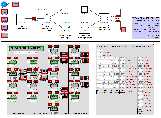
Complex Business Process Model with Interleaved Labor Resources The business simulation model shown at the right was created to obtain information about the possible reorganization of three separate work teams and processes into one process under one administrative group. The impetus for the investigation was ostensibly that there was (cont.) |
|
|---|
|
My History with
Modeling, Simulators and Simulations Deterministic and stochastic modeling and analysis have been a large part of my professional life. Deterministic, linear / non-linear structural finite element modeling and analysis came first, followed more recently by stochastic business and IT modeling and analysis. To achieve quality results with either model type, many of the same developmental and analytical principals apply (cont.) |
|
|---|
References:
(1) Averill M. Law and Kelton, W. David: "Simulation Modeling and Analysis"; Raj Jain: "The Art of Computer Systems Performance Analysis"; Bernard P. Zeigler, Praehofer, Herbert, Kim, Tag Gon: "Theory of Modeling and Simulation".
Site managed with MyEclipse, a multi-language, multi-platform IDE