My History with Modeling, Simulators and Simulations
 Deterministic and stochastic modeling and analysis have been a large
part of my professional life. Deterministic, linear /
non-linear structural finite element modeling and analysis came
first, followed more recently by stochastic business and IT modeling
and analysis. To achieve quality results with either model
type, many of the same developmental and analytical principals apply
-- though stochastic applications obviously require an additional
probability and statistics knowledge. See Notes on Systems Modeling for
more general modeling substance and Probability and
Statistics Notes for additional information on the technical side of
stochastic modeling. For dial-up connection speeds, these
documents may take several minutes to download. The figure at
left presents my overview of model-driven design/analysis, a superset of
simulation design/analysis. See the glossary for definitions of
Analysis, Domain and Modeling Experts.
Deterministic and stochastic modeling and analysis have been a large
part of my professional life. Deterministic, linear /
non-linear structural finite element modeling and analysis came
first, followed more recently by stochastic business and IT modeling
and analysis. To achieve quality results with either model
type, many of the same developmental and analytical principals apply
-- though stochastic applications obviously require an additional
probability and statistics knowledge. See Notes on Systems Modeling for
more general modeling substance and Probability and
Statistics Notes for additional information on the technical side of
stochastic modeling. For dial-up connection speeds, these
documents may take several minutes to download. The figure at
left presents my overview of model-driven design/analysis, a superset of
simulation design/analysis. See the glossary for definitions of
Analysis, Domain and Modeling Experts.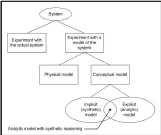 More specifically, my deterministic modeling and analysis has been
in the area of discrete/static/deterministic (an explicit numerical
solution technique, reference figure at right) -- structural modeling
and analysis that involved both linear and non-linear material
properties (e.g. aluminum/steel and fiberglass/Kevlar), and small and
large displacements (e.g. stresses/strains from discrete wind loads
and bifurcation buckling patterns). In the aerospace industry,
analyses were of spacecraft and missile components; in the offshore
industry, analyses involved large tubular joint intersections and
other offshore structure component parts. Significant
deterministic modeling accomplishments are formulating and
implementing an aposteriori finite element error estimate technique
(see reference 'a' below), and developing and releasing to the
general public an interactive, finite element modeling and
post-processing environment (see reference 'b' below).
More specifically, my deterministic modeling and analysis has been
in the area of discrete/static/deterministic (an explicit numerical
solution technique, reference figure at right) -- structural modeling
and analysis that involved both linear and non-linear material
properties (e.g. aluminum/steel and fiberglass/Kevlar), and small and
large displacements (e.g. stresses/strains from discrete wind loads
and bifurcation buckling patterns). In the aerospace industry,
analyses were of spacecraft and missile components; in the offshore
industry, analyses involved large tubular joint intersections and
other offshore structure component parts. Significant
deterministic modeling accomplishments are formulating and
implementing an aposteriori finite element error estimate technique
(see reference 'a' below), and developing and releasing to the
general public an interactive, finite element modeling and
post-processing environment (see reference 'b' below). My stochastic experience has been in the
discrete&continuous/dynamic/stochastic area (also an explicit
numerical solution technique, reference figure at right2
and Notes on Systems Modeling)
-- business process modeling and analysis that has included process
cost optimization, resource interaction and
utilization, and technical server coordination,
throughput estimation and bottleneck determination. These
stochastic models help upper and middle management have confidence in
resource, budget and technical equipment forecasting for projected
customer loads (e.g., reference the "General IT
Architecture" results-summary figure at the left and the
associated General IT Architecture model
explanation).
My stochastic experience has been in the
discrete&continuous/dynamic/stochastic area (also an explicit
numerical solution technique, reference figure at right2
and Notes on Systems Modeling)
-- business process modeling and analysis that has included process
cost optimization, resource interaction and
utilization, and technical server coordination,
throughput estimation and bottleneck determination. These
stochastic models help upper and middle management have confidence in
resource, budget and technical equipment forecasting for projected
customer loads (e.g., reference the "General IT
Architecture" results-summary figure at the left and the
associated General IT Architecture model
explanation).References:
(1) Figure partially based on information in "Theory of Modeling and Simulation", Zeigler, B. P. et.al., Academic Press, 2000.
(2) Figure based on information in "Simulation Modeling & Analysis", Law, A. M. and Kelton, W. David, McGraw Hill, 1991.
(a) "Practical Applications of Adaptive Mesh Refinement (Rezoning)", R.E. Hoffman, Guerra, F.M., Humphrey, D.L.; Computers and Structures, Vol. 12, pp. 639-655.
(b) "IMPRESS Finite Element Modeling System", R.E. Hoffman, Earl and Wright Consulting Engineers, United Computing Services.
Site managed with MyEclipse, a multi-language, multi-platform IDE